Great Britain
Day 16 - Friday, 23 May 1997
Grayfriar's Bobby
Have you ever seen the movie Grayfriar's Bobby (a Disney production?) It's a true story. There was a policeman in Edinburgh who walked a beat with his little dog alongside. The policeman died and was buried. His little dog, Bobby, spent the rest of his life at his masters grave, going around to the neighbors for food, and returning faithfully to the grave every night. There is a statue erected to Bobby, and when he died, he was buried just outside the cemetery where his master lies.
Cemeteries in this city had to be guarded when there was a fresh grave, since the early surgeons paid cash for dead bodies, no questions asked. The fresher the body, the higher the payment. This practice led to certain men setting up a hotel in which people checked in but did not live to see the next day. I think they kept the streets pretty clear of homeless until they were caught and prosecuted, beheaded in the main square - and then given to the surgeons.
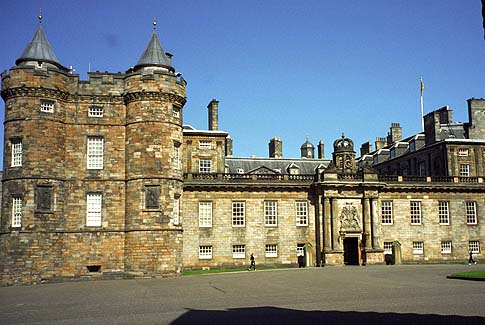
Holyrood Palace
The Holyrood Palace in Edinburgh was not available for tours while we were there because there was an Assembly of the Kirk (church) of Scotland taking place while we were there. It had been going on for some days. I had heard some of the news of their discussions on the radio when we were in Oban. They discussed whether smoking marijuana was a sin or just a bad habit. Someone cleverly suggested it was a stupidity. Apparently they deal with much the same problems that we do. In one news clip I heard it mentioned that for the next Assembly they will take up the issue of children who are disobedient to parents, and whether they should be stoned. At least I think that's what they said. It could be that I misunderstood.
Edinburgh Castle
We were able to visit the castle, a marvelous stone structure built on top of a volcanic rock. It was in this castle that we saw the memorial to Scots who died in war. There were two books, one for each of the world wars, listing the names of the Scottish men who died in those events. Looking for family names, I found some Stevens (my mothers) and many Porters (my fathers name). In the B&B, I picked up a book called "Scots Kith and Kin" and found the following entry:
Porter - Lanarkshire, Angus, etc. 13th Century
dc Glenlyon; McNaughton
McNaughton, on another page, carried this information:
Ancient name: Nechtan
borne by 4 Pictish kings
A map in the book showed that this clan lived in the area south of Oban, near Iona.
The McNaughton family crest carries the words "I hope in God."
On Loch Ness, we had visited the ruins of the castle Urquhart - the capital of Pictish kingdom. The king in residence there in St. Columba's day was named Brude. St. Columba visited him, and converted many Picts to Christianity in 563. Perhaps my ancestral family became Christians because of St. Columba of Iona, Scotland.
Wandering around Edinburgh
Dr. David Livingstone, the Christian who opened up the heart of Africa to Christianity and to trade, is buried in St. Giles church here. There is a statue of him in the beautiful Princes Street park, in the shadow of a huge monument erected to Sir Walter Scott. Edinburgh was also home to the poet Robert Burns, and to that famous actor, Sean Connery. This city is the origin of the Dr. Jekyl and Mr. Hyde story, which had some basis in fact.
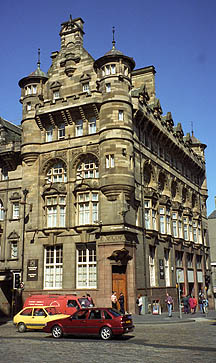
The picture to the left shows a very ornate building that is typical of Edinburgh's buildings.
We walked along Princes Street and the Royal Mile. We marveled at the train station on the old lake bed and quite out of view, trains coming and going through the heart of the city without any interruption of the normal city sounds. We peered through the gates at the palace and the ruined abbey beside it. We dawdled in the park and gazed at the Forth of Firth. We dallied in the castle and watched the changing of the guard.
Two nights, a day and a half, were not enough for this city. We could easily spend five days or a week in Edinburgh and still not absorb all there is to see in this interesting and wonderful city.