Great Britain
Day 19 - Monday, 26 May 1997
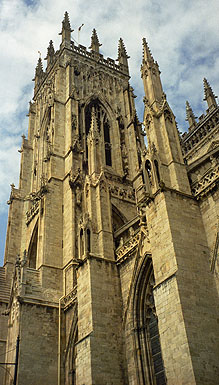
We visited York Minster, going deep underground where the old Roman foundations have been excavated. The Minster was starting to sink, and they had to go under it to strengthen the foundations. When they did so, they found the remains of the original structure.
"The first building on the Minster site was not a church, but the army headquarters from which the Romans administered the north of England. In AD 306, Constantine accompanied his father, the Emperor, to York. During the visit, his father died, and Constantine was hailed as Caesar by the troops. He returned to Rome to secure his claim and six years later, in 312, he declared Christianity a permitted religion of the empire."
This is a quote from the York Minster guide that we bought here. Many of you probably know a great deal more about Constantine*, who is also responsible for establishing Sunday as a day of rest. Before him, there was no such thing as a weekend, apparently!
The minster today is a wonderfully impressive structure, beautiful inside and out. We toured the building, but again, there was not enough time to take in all the marvelous details of a building that was under construction or being rebuilt or added onto for over 1000 years. York was another city that deserved more time than we could devote to it. Two nights was not enough.
Betty's Tea Room
The second night we had dinner at Betty's tea room, with a view of the town square convenient for watching people come and go. It was a delightful place and the waitress never hurried us at all, so we dawdled over dessert and stared out the window until some teenage boys sat down outside and started staring back at us.

We wandered down by the river and caught a riverboat for a 30 minute cruise on the River Ouse. The ride took us past the town, and past a group on the shore that was taking the "Ghost Tour." Ghost tours seemed to be in every town, taking people into dark haunts to hear gruesome tales and scaring some people into heart attacks. Our guide told us about a company who had to go out of business because that happened to one of their customers.
Our B&B here was "en suite," meaning the bathroom was inside the room, which was to be our last private bath. The host and hostess, Margaret and David Tyce, were charming people, and the home was lovely. We met a young couple from Los Angeles, he was a Presbyterian Theological student. We enjoyed talking to them. They had been in England for a year and were returning to LA in four weeks.
Our hosts had a little dog who sat outside the breakfast room window and entertained the guests by chasing birds.
We turned the car in here and bought train tickets to London.
* Just a little more detail on Constantine: quoted from Halleys Bible Handbook.
"His Conversion. In the course of his wars with competitors, to establish himself on the throne, on the eve of the battle of Milvain Bridge, just outside Rome (October 27, A.D. 312) he saw in the sky, just above the setting sun, a vision of the Cross, and above it the words, "In this sign conquer." He decided to fight under the banner of Christ, and he won the battle, a turning point in the history of Christianity.
His edict of Toleration (A.D. 313). By this Edict, Constantine granted to "Christians and to all others Full Liberty of following that Religion which each may choose," the first edict of its kind in history. He went further. He favored Christians in every way; filled chief offices with them; exempted Christian ministers from taxes and military service; encouraged and helped in building Churches; made Christianity the Religion of his Court; issued a general exhortation (A.D. 325) to all his subjects, to embrace Christianity; and because the Roman Aristocracy persisted in adhering to their Pagan Religions, Constantine moved his Capitol to Byzantium, and called it Constantinople, "New Rome," Capital of the New Christian Empire.
Constantine and Sunday. He made the Christians day of Assembly, Sunday, a Rest Day; forbidding ordinary work; permitting Christian soldiers to attend Church services. This Rest for One Day a week meant much for slaves.
Reforms. Slavery, Gladiatorial Fights, Killing of Unwelcome Children and Crucifixion as a form of execution were abolished with the Christianization of the Roman Empire."