Turkmenistan & Uzbekistan
Day 2 -
Sunday, 23 April 2000
Ashgabat, Turkmenistan
Early in the morning, we drove out to the Sunday Bazaar, the second largest market in Asia. (Wonder where the largest one is?)
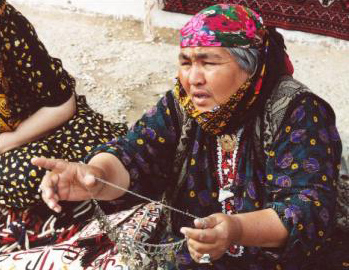
We wandered, bargained, bought treasures, took pictures and were generally astonished at this market where goods from many surrounding countries and from the locals are being sold. Women sit on the ground and sell jewelry, fabrics and embroideries. I passed over the jewelry, but I bought fabric and an embroidery. Our guide, Atajohn, told me his sister could make the dress for me. The material for the dress and the embrodery were $16 each. Atajohn's sister charged $5 to turn these items into a dress.
I also bought a small carpet with an interesting design. A bride is sitting on a camel, below are images of cars. Atajohn told me, "Before brides rode in cars, they rode on camels." The bride on the carpet is swathed in bridal clothes and jewelry. Later we learned that a bride usually wears 16 kilograms of jewelry! As the children come along, she is allowed to take off a little for each child.
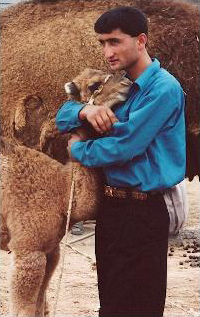
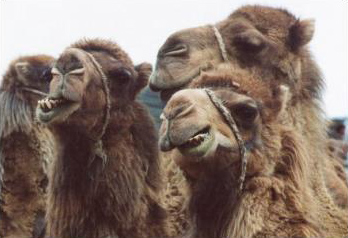
We went to the animal section of the market and took more pictures. The camels are great subjects for photography. The young man hugging his camel and the boy with a lamb over his shoulders were irresistible. There was a great ox standing among the cattle. When I showed interest in him and began to take pictures, an order was given and someone came to lead him away.
There is an interesting thing about photography here. Many people are very eager to get into the picture, especially the children and their mothers. But there are a few of the older men who don't want to be photographed. One spectacularly photogenic old man near the entrance of the bazaar caught my attention. When I motioned to the camera to ask his permission he immediately became angry, picked up his stick and shook it at me. I apologized with gestures and walked away. For some reason, I think the old men who owned the ox felt the same way: they didn't want me to take pictures of the ox.
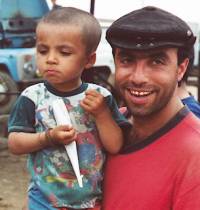
A little boy in his father's arms shared his sunflower seeds with me, so I reached into my bag and shared my almonds with him. He seemed astonished at my appearance. When I look at the pictures, I can understand why the people stared at us as much as we stared at them. My short, uncovered hair, my western slacks and tee-shirts were a contrast to the women in traditional dresses with embroideries, wearing scarves to cover their hair.
After the bazaar, we went to the hippodrome. This word means racetrack. The horses were running, but there was apparently no charge to enter the facility. We watched a couple of races, and saw the winner draped with a carpet, the runner-up draped with a bright Russian scarf. The horses run clockwise around the track. In the stands were many interesting people. Old men wearing the traditional round sheepskin hats made a dramatic contrast to the men in our group.
Our next stop was the new ethnographic museum. We were not allowed to take pictures, and it's a real shame we could not photograph our guide. She was a beautiful young lady who usually leads tours in Arabic, but she guided us through the museum in perfect, unaccented English. Her knowledge and familiarity with the exhibits was astounding, filling our heads with more information than we could absorb.
In the museum, we start with the artifacts of the 12,000 BC stone age finds from near the Caspian Sea, the 6,000 BC Jakonian agricultural implements, and pottery from 4,000 BC. There are many artifacts from the temples dating from 3,000 - 2,000 BC, including writings, a gold head of a wolf, and one of a bull. The sacred fires of the Zoroastrians were burned on the top of a 3-step temple. The Avesta was written about 2,000 BC, and the scorpion was a sacred symbol. There are ossuaries (containers for bones of dead persons) complete with bones. The Zorastrian ceremonies for death rites included bringing the dead body to an enclosed building that was open to the sky. The buildings were called "towers of silence." The body was left exposed to the sun and the birds, until the bones were picked clean. Then the bones were placed in an ossuary. If the person was a man, the ossuary held a sword or knives. For a woman, it held beads, and for a child, toys were enclosed.
A quick search on the internet reveals much information is posted concerning Zoroastrianism, and that there is a very active community in the world today. A man can even find a Zoroastrian wife through a website which seeks to have Zoroastrianism grow by marriage between believers and subsequent birth of children. There are communities in Ontario and at Stanford.
Our guide told us of a tombstone of a little 8-year-old girl, with the text written in the ancient Aramaic language. The carved picture on the stone showed her holding grapes, to symbolize youth, and a bird, which symbolized the soul.
A bust of Alexander the Great on display is a copy of the original that is in the museum in Istanbul. Alexander's conquest of this territory started a new culture, the Parthian empire. The city of Old Nisa is an example of this period, which lasted from 300 BC to 300 AD, and is characterized by square buildings, and decorations of leaves of acanthus. A statue of a goddess from the ruins of Old Nisa is dressed as the Greek culture, but the face has features of the local people. Another item shows a Greek dress adapted to the local style. There is also a mask, representative of Greek theatre. There is a crock with Aramaic inscriptions, and some quite marvelous ivory horns decorated with a frieze around the top and mythological animals at the bottom. Altogether, the items show a blending of Greek and Iranian cultures.
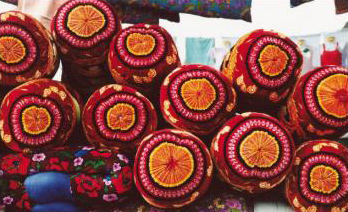
This photo of colorful bolsters was taken at the market. Cameras were not allowed in the museum.
As we moved into the third hall, we change time periods, to the 5th century. A huge head of Buddha is most dominant. There is a decorated vase that holds papers. The painting on the outside of the vase tells a story, of a man and a woman celebrating. The man is seen hunting, then ill, then dead. These two items were found in Merv. We'll visit Merv tomorrow.
The next section is Islamic art, with ceramics, including ceramic lamps. Green glazed ceramics were found, as well as ceramics that were stamped to show ownership.
We moved on to the 17th, 18th, 19th centuries and saw steel knives and iron armament. Sabers and long guns were here, which reminded me of "The night of the Long Knives," a story written by Peter Hopkirk in "The Great Game." In fact, this entire exhibit reminds me of the adventures in that book. It was during this time that the Russians and the British competed for dominance in Central Asia - and Russia won.
A less somber exhibit shows examples of bridal jewelry, which resembles the armor of Amazonian tribes. There are little containers for sacred scriptures which were worn on forehead, chest, or wrist. The guide told us that the females were kept in silence and expressed her emotions in the clothing that she wore. When a woman reached 63, it was considered a sacred age, and she was allowed to wear white.
Medical plants are exhibited here, 16 of which grow naturally in this area. Snake venom is also used as medicine.
Here is the second "Great Carpet" covering a wall at one end of the building. The statistics on this carpet are:
- length - 12,90 meters (42.3 feet)
- width - 20,62 meters (67.6 feet)
- total area - 266 square meters (2,863 square feet)
- thickness - 1 square meter has 400,000 knots
- weight - 1 metric ton (1.1 US tons)
Leaving the museum, we passed an orphanage which was built in 1997. Children in the orphanage learn foreign languages as well as principles of Islam. The guide told us a story about the president of Turkmenistan, who was an orphan and therefore has sympathy for orphans. His father had been killed in World War II, and the rest of his family was killed in the 1948 earthquake.
We arrived at the archeological site of Old Nisa late in the day, with a fierce wind blowing, and great drops of rain falling. But we took a chance, and went out to the city for a closer look at remains of the old mud walls. The rain stopped, but the wind challenged those of us who walked out on the walls. There wasn't much to see or photograph. The story of the city was told in the artifacts that are now in the museum.
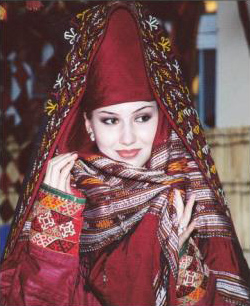
In the evening we went to a private home for a buffet dinner, a folklore show, and a fashion show. The beautiful young lady shown here was one of the three models who showed us local fashioins.