Turkmenistan & Uzbekistan
Day 6 - Thursday, 27 April 2000
Urgench & Khiva
To compensate for the bad hotel experience last night, we had a wonderful tour guide named Albena who led us through the monuments of Konya Urgench, or Old Urgench, and taught us much.
In the bus, she began by telling us that a persons dress indicates the socio-economic group. She told us about herself, how in 1949 and 1950, her parents knew it was necessary for her to know Russian, so they spoke to her only in Russian. She learned Turkmen only when she was 20 years old. But she heard it from childhood, we determined, so perhaps it was not too difficult to learn. Her English is quite good. We forgot to ask when she learned English.
Last September she had flown to Chicago by special invitation, and there she wore her traditional dress. People from 213 countries were there, all in their own native dress. They talked to each other in English or Spanish. It was a wonderful experience for her.
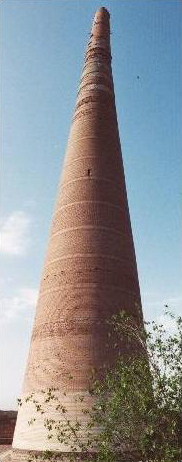
The Kutluk Timur Minaret (right) stands 203 feet tall at Konya
Urgench. It is said to be the tallest in Central Asia. It was built starting
about 1320. The top of the structure leans to the west.
In the 16th century, the river (Amu Darya) changed course, and was 40 km further away from the city. That is a long way to carry water in buckets for all your daily needs, and the people moved to New Urgench. The name Amu Darya means "can change its way," she told us.
"The Turkmen people are lazy," she said (she is Russian), and "don't grow anything but animals." By contrast, the Uzbek people are tillers of the soil, and plant vegetables, trees and gardens.
Fruits and vegetables are cheap here, near the Uzbek border. In Ashgabat, clothing is cheap. The standard of living in Turkmenistan is better than in Russia.
Since the Russians have been growing cotton here, and irrigating the land with water from the river, the water table has become very high due to seepage from the many unlined canals. Intensive irrigation has left the soil very salty. In order to plant anything here, the land must first be washed seven times in spring. This is done by flooding the fields with river water. The state areas have priority on the water.
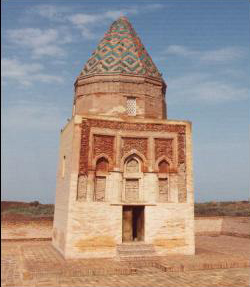
At left is the Il-Arsian mausoleum with its unique 12-sided
conical dome. The father of Tekesh lies here. He (the father) lived in the
1100s.
School begins for the village children on December 1, and the children must pick cotton after school. Right now the fields are green with wheat. The wheat harvest is mid-June. The president comes for the harvest. The people must be educated and healthy, he says.
The horse is the pride of the Turkmen people. Their houses are built of mud. The youngest son must live with the parents.
A married woman wears a head scarf and a long dress. The people don't like cotton, it is the fabric worn by the poor families. Many people have gold teeth in front. It is not because they had problems with their teeth, but because they want to show their riches. "It is more important to show their wealth," said Albena, "than to raise their standard of living."
So if they can, they buy a camel for the same reason, to show their wealth. (Meli didn't think this was correct, but she believed that the camel could help the family to make money.) One camel is worth about $300. A family with five camels is very rich. They can use the milk and the wool, Meli said.
I remember that Atajohn pointed out some women beside the road selling something, a drink of some kind, made from camel's milk. None of us was interested in tasting it. I also saw some carpets in Istanbul, made from camel's hair. They were different in color and very attractive.
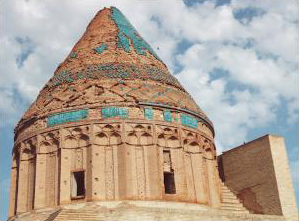
At right is the brick conical dome
topping the mausoleum of Tekesh.
Daughters are taught carpet weaving so that they can earn money in the carpet factories. (Wouldn't it be nice if they could market their own carpets, and not just work for the state?)
A bride, said Albena, could be worth $1000 to a family who needed a wife for their son. But if the woman had been educated, her value was less. In the arranged marriages, the bride becomes a slave for her mother-in-law. The daughter-in-law must sit separately from the husband's parents. With her head scarf, she must cover her mouth, and is not allowed to talk to her mother-in-law. Covering her mouth with the scarf indicates that she is to stay in silence. As a sign of her obedience to these rules, the new bride must make three deep bows to her mother-in-law.
Old men wear fur hats, wide trousers and a robe. "We prefer to suffer our own heat rather than the heat of the sun," is their attitude, according to Albena.
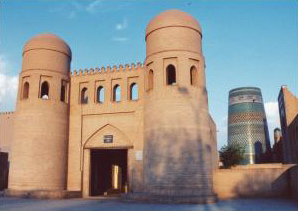
At left is the west gate of Khiva. The
Kalta Minar minaret can be seen on the right side of the photo. It reminds me
of a nuclear plant cooling tower.
State schools teach American English. In the past, diplomas could be bought. Albena and her husband are both teachers, and earn $25 a month for this work. The cost for private school for a student is $100 per month.
The official rate of exchange is 5,500 menat per $1 U.S. On the black market, as of yesterday she said, it is 16,000 menat per U.S. $1. The day before it was 15,000 menat per dollar.
Albena told us that she always carries a piece of scripture, from the Koran, written in Arabic on leather, as protection from the evil eye. "I didn't always believe," she said, "But now I believe." When I asked her why, she told me a story of a time when she and her husband were having trouble, and she had severe health problems. A woman told her that someone had put a curse on her. She was told that she would find a certain amulet near the gate of her house. She was to bring it back to the woman, who would then know what to do to break the curse. The scripture on leather is the result. The problems in her marriage cleared up. Her health also was recovered. So now she believes.
A monument that we visited, Torebeg Khanym, is not a mausoleum, she told us, because it has windows. Also, when it was excavated, no graves were found, but secret passage tunnels were discovered. Perhaps it was a palace.
A nearby cemetery has some round graves, with ladders beside them. Some of the ladders lie beside the grave, other ladders stand at one side of the grave. Albena told us that the standing ones are for men, so they can climb up and go straight to heaven. The women must wait 37,000 years before they can go to heaven. Meli didn't believe this either, and talked with some local women who seemed to not believe Albena's ladder story. Utkir told us something about women's sins being deeper than men's. So who knows what the true story is here. Maybe no one really knows. I don't know how old the graves are, but they appear to be fairly recent.
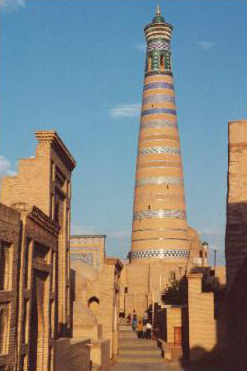
The Islam Khodja minaret
was built in the early 1900s. It is Khiva's tallest at 148 feet.
We also visited a building that was mysterious, and Meli believed it to be a "teke" which is a building in a Muslim school, specific to the teaching of theology. Albena listened to her, and as we walked away, she told me that when someone tells her such information, she "writes it down" in her mind. The Russians trained the tour guides, giving them specific information that they could tell people. Since independence, the guides are learning new things. So perhaps we should take it all with a healthy dose of skepticism. It is all so old, and without a continuity of history, there is much that is guesswork.
On one mausoleum, an Arabic inscription says "Deny all good things of life - the grave is the beginning of happiness." The people who believed this philosophy, said Albena, were easily defeated by their conquerors.
After lunch at the Korean restaurant, we drove to the border, where our papers and passports were duly expected. It took an hour to get through. Much of that time was spent filling out customs forms. We had to declare what we had with us, money, jewelry, etc., for the customs agents.
It was late in the afternoon when we arrived in Khiva, and the sun shone dramatically on the western face of the great wall and its huge entrance. It has been perhaps too perfectly reconstructed, and someone has aptly called it a sterilized monument to the past.
After Khiva, we drove to New Urgench and slept in a better hotel.