Turkmenistan & Uzbekistan
Day 9 - Sunday, 30 April 2000
This day was to be a long trip by bus to Bukhara. It was at this point that Jim and I decided there was just too much bus-riding for our taste, and started to talk to each other about how the trip could have been streamlined to eliminate some of it. A lot of the bus travel is unavoidable. There is just no other way to visit the monuments that are out in the desert, except to drive to them. And since they often lie between two cities, driving is a way to see the sights as well as get to the next city.
Anyway, the day I spend sleeping at the hotel helped me a lot, and this long day on the bus ended in another exciting place.
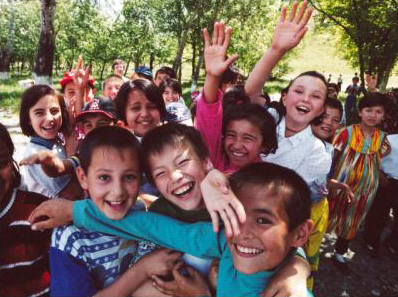
I simply walked into a group of
kids with my camera and waited for them to crowd around me. It took just a few
seconds. I said nothing. They couldn't understand me anyway. These are happy
kids.
Our driver is name Ibragim, and his helper is Sukan. Sukan is Tajik. Tajikistan is currently a dangerous place for tourists, because of terrorism and unrest. The Tajik people are not only in Tajikistan, however. When the Soviets drew the lines to demarcate the countries, they did not always do it in the way the nations of peoples here would have done it. So there is some dispute about where the lines should be. In the meantime, the people live and work together, interacting with each other as they have always done.
Utkir talked to us and entertained us as we drove, telling us about the countryside, the silkworm industry, and the people. He told us about his big family, 11 children. He has 5 sisters and 5 brothers, and he is the youngest son and the middle child. Two brothers are farmers, and one sister is married to a farmer. One brother is a martial arts instructor and has a photography shop. One brother and one brother-in-law are businessmen with small shops. One sister is a lady tractor driver. The oldest brother is an entomologist, working to protect the grain and cotton crops.
The youngest, 18-year old sister is studying sewing. Utkir also wants his wife to study sewing. It is another source of income, but I think Dilaram wants to be a diplomat. She would be a good diplomat, too. Although only 18 years old, she is very gracious, charming and mature, as well as intelligent. She has been studying English, 3-hour classes, 3 days a week, for the past year and is doing very well. I greatly enjoyed talking to her.
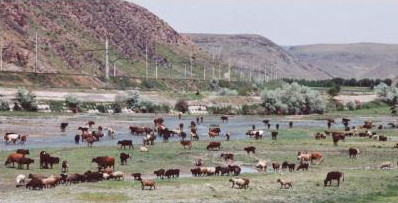
This picture makes me think of the
Rio Grande in New Mexico. There is, however, a lot more water in this river
than in the Rio Grande.
Utkir says that where cotton or potatoes have grown, the nutrients are gone from the land. After picking, wheat is planted among the cotton stalks. The next year wheat is planted, then a short crop, then alfalfa. Then cotton can be planted again. Herbs and strawberries are grown in greenhouses. Apple and quince trees are planted in orchards, and grapevines grow on wire trellises. It is popular to plant a grapevine in front of a home, trained to slant upwards toward the wall. In addition to the fruit, it provides shade in the hot summer months. Each house also has a small garden to grow such vegetables as tomatoes and cucumbers.
Poppies grow wild, and the local people use the dried powdered flowers of the opium poppy as medicine for colds or stomach problems. They do not, however, use the tarry sap that is used in the production of harder drugs. The neighboring country of Tajikistan produces these drugs, and bring them into the country. The penalties for such traffic are high, and the police who stop cars between cities must be constantly watching for smugglers. The people have to have a visa to travel from one city to another, and everyone over the age of 16 must have a passport.
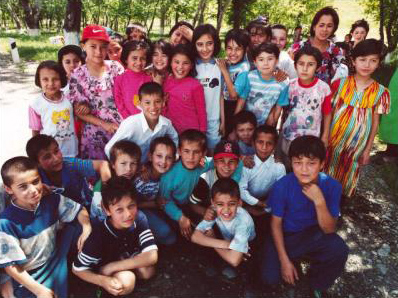
These children were drawn to the
camera like moths to a flame. They are remarkably efficient when it comes to
lining up for a group picture. I think a teacher helped a little in arranging
these kids but they did most of the work themselves.
Since the government wants to encourage people to live in the countryside, someone who wants to live in the city must have a permit. However, anyone who wants to live in the village or provinces can have 1/4 hectare (there are 2.5 acres in a hectare) of land free on which to build a house.
Another way to live in the country is to rent land. Two hectares can be rented for one year for $200. If the crops do well, the farmer can make $1000 profit on those two hectares. Wheat, which was formerly planted only be the government, is now permitted to be planted by private persons.
We crossed over a mountainous ridge, through Timur Gate (or Pass) and entered into different terrain. On our right was the Sangzar River, and on the left a forested area, with a large park. But it was probably the bee boxes loaded onto a parked trailer that caused Meli to cry out to the driver to stop the bus. Libby has been keeping and working with bees for a few years, and naturally has a high interest in how bees are tended here. So off she dashed to the bees, while Meli went to the children playing under the trees. Jim went out with his camera to capture the shy but colorfully dressed little girl with flowers in her hand. When we finally got back on the bus, Meli also had flowers in her hair.
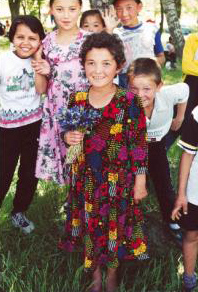
I noticed the shy little
girl in the flower dress with flowers in her hand while I taking pictures of
the other kids. I tried to get a picture of just her but other children kept
crowding in. A teacher saw what was happening and helped me get this shot. I
hope I made the little girl's day.
Across the road in the valley where the river meandered, cows grazed (photo above), and at some distance a group of boys were swimming naked in the river. It altogether was a very pleasant stop, but we could not dally long. There were many miles yet before us.
We finally arrived at the world-famous potter Gijduval Alishir's workshop, to watch him at his potter's bench, to gain more knowledge about the art of pottery, and to have dinner at his house. While dinner was being served, we were shown a video tape of Mr. Alishir's trip to Japan.
It was a short drive from there to Hotel Bukhara, where we would stay two nights.