Stockholm, Sweden
Day 10 - Friday, 11 August 2000
Today started at the Vasa Museum. The Vasa was the finest war ship of its day. Unfortunately it sank a couple of kilometers into its maiden voyage.
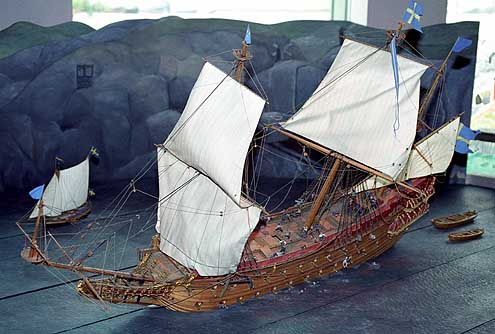
In the 1950s, a crew of dedicated preservationists lifted her, virtually intact, from her watery grave and gave her a new home in the museum. Since the Baltic Sea is not salty, there are no sea worms there, which would have eaten and destroyed the wooden ship.
Rescuers dug tunnels under the ship, ran steel cables underneath and lifted her. The hull came up in one piece. Another 14,000 pieces were found nearby. The cannons had been salvaged in the 17th century.
In dock she was cleaned and sprayed with polyethylene glycol. The preservation process took a long time - from 1962 to 1979. Since 1990 she has been sitting where we saw her, in a dimly lit museum. The wood is still not dry, so the humidity and low light must be maintained.
Anna guided us through the museum. The ship Vasa was ordered in 1625, and was to be sent as quickly as possible into battle in Poland where the Swedes were fighting. She was completed in 1628, and sank on her maiden voyage in the harbor where the water was only 30 meters deep.
Thirty to fifty people drowned with Vasa. There are many versions of why she sank. Some have suggested the crew was drunk. The wind, it seems, was coming from the wrong direction. There were 64 cannons on board and it isn't clear whether they were anchored in place. Further, the construction was high and narrow. Was it too high, too narrow? The Swedes had to win the war without her. But win they did, in 1629, just a year later.
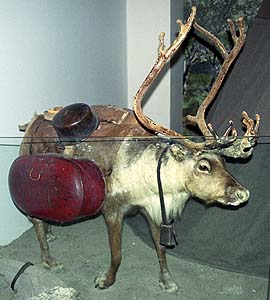
A short walk from the Vasa we visited the Nordic Museum. It holds a wonderful exhibit on the Sami people, the only indigenous minority group in the Nordic countries. We know them as Laplanders.
The Samis speak a language related to Finnish (which is related to Turkish). There are reindeer Sami, sea-going Sami, and hunter-gatherer Sami.
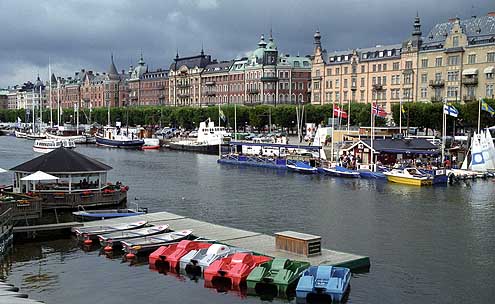
This is a view looking toward the center of Stockholm from a bridge we crossed while walking from the Nordic Museum to the Museum of National Antiquities. The buildings are on Standvagen.
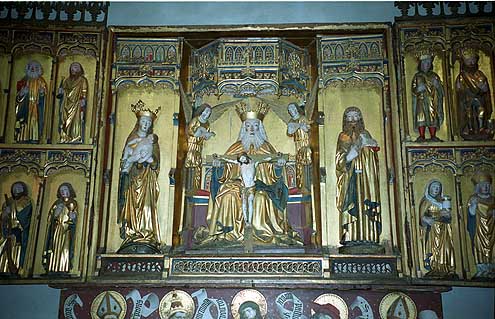
The Museum of National Antiquities was very interesting. It is arranged in order through the ages: Stone, Neolithic, Iron, Bronze. There is an extensive collection on church history (above). It was definitely a worthwhile visit. It is built around a courtyard where children were learning skills that children of early times would have learned.