Norway in a Nutshell
Day 17 - Friday, 18 August 2000
Dave's schedule for today: breakfast is available at 6:30, we will meet at 10:45 to visit three museums, at 4:30 we will meet with Tom and Judy to learn the name of their new granddaughter, at 5:30 we will take the funicular to the top of Mt. Fløyen to have dinner at 6:30. Our last day of the tour will be a full one.
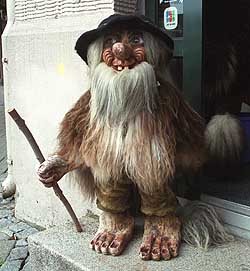
We met Jeremy, our local guide, at the Bergen Museum at 11 AM. He showed us evidence that the museum had been built over the remains of old buildings. Many fires in the past have destroyed the town over and over, and they just rebuilt over top of the ruins. The layers are from as far back as 1170 AD, there is one from 1198, and the latest one was 1955. The city is designed in a "double tenement" formation, which means two parallel rows of homes with a passageway in between. This makes an easy pathway for fire.
We saw merchant vessels, with a reconstructed cross-section made of pine from western Norway. These vessels were used in the 1100s and 1200s in the trade between Norway and England. Norway exported barrels of cod liver oil and dried fish. Stottfish, cod, and pollock, were caught in the icy seas, were gutted, salted and dried. Twice a year the boats brought in the fish. These fish were important for Roman Catholic countries where people did not eat meat on Fridays or for other fasting periods.
The Hanseatic League, the northern Germans, were better at trade than the Norwegians. (Hansa means trade community.) They increased the trade by adding grains, textiles, pottery, herbs, sugar and salt. The Spaniards and the Dutch established trade routes to America. Barrels, five feet tall, were used to import grains. Some of the excavated barrels had been damaged by fire.
Much of the lecture centered around the importance of protection against fire. The houses were built in a row and had no heating or cooking facilities. The cooking was all done in one house at the end of the row. Everyone gathered there to cook, eat and assemble for any given purpose, such as meetings.
Archeologists have found evidence of many types of trades. There was a shoemaker, a tailor, and a comb maker who also made games and needles of bone and wood. Evidence shows that a blacksmith/goldsmith (gold rings were found in the latrine) lived in a stone house, separate from the row houses. Toys and skates are found from pre-Hanseatic days. During the Hanseatic period, there were men only. They were denied marriage.
Skulls from 1349 have been found that indicate they died of black plague. This dread disease wiped out two-thirds of the population. The skulls have good teeth, although the teeth are worn down in skulls of older people. Life expectancy was about 30 years. The men were about 5'3" tall while the women stood about 4'11".
Outside, we saw the Church of St. Mary from early 1100s. It has twin towers in the Roman style, but was later modified into a Gothic style and used by the Germans up to 1870s. The German language was used for the services. A wall was built to prevent mixing between Norwegians and Germans.
The remains of a private church, St. LaBrensad(?) are nearby. Bergen was the ecclesiastical center of Norway during the middle ages. There were 13 churches and 5 monasteries. The reformation came here in 1536.
There was a tremendous explosion in the harbor in 1944. Tons of TNT had been stored next to a boiler room. 130 people were killed, and many were blinded.
By the 19th century, this had become a slum area, inhabited by drunks and rats. In 1910 the city council wanted to demolish it, but the citizenry rose up to save it.
The Hanseatic Museum is a building that dates to 1876, it is a place where fish were processed for the tradesmen. The cod liver oil was put in barrels, the fish were salted and put in barrels under a fish press. The men who did the work lived here. One manager, one journeyman, and eight apprentices would be housed in the same building. Up to 2,000 men would live in the community at any given time.
A young man could get a job here as an apprentice when he was age 13 or 14. Most came from middle class families, and served for six years. They ate cold porridge served in tin dishes, with a light beer diluted with water in a stein. There was one stein for everyone, and it had rivets to show how much each man was allowed to drink. If someone drank more than his share, he had to pay a fine.
This museum is filled with interesting things like a coat of arms, or Lubbeck's seal, which is the symbol of Germany - a crown above a fish. Crown fish cod were considered to be good luck. A dried sturgeon from Russia is 120 years old. Horsehide buckets were sitting around filled with water in case a fire needed to be dowsed. A cod-liver-oil lamp hangs suspended from the ceiling - pour in cod liver oil, add a wick. A knotted rope with small nails inserted was used for discipline.
The first room we entered was the area where the men ate, it was also a reception room. A secret passageway led to the liquor cabinet. In the manager's private room, was the office for doing the bookkeeping. (The owner lived in Germany.) The manager also had a winter bedroom, which was in the center of the house for greater warmth. The journeyman's bedchamber had an extra door for access to his bed. An apprentice would make the bed, but was not allowed into the room itself. Thus, he had to reach through this door and make the bed from the outside. The beds were in cupboards built against the walls. The apprentices slept two per bunk, and were shut in at night by the journeyman. They could not get out again until he opened it in the morning.
Jim and I become separated before we reached the last museum. While waiting for people to move on so he could get a better picture, he was left behind. The group rounded a corner and entered the museum. When he came out, he didn't know which building we went into. So after a period of time, he went back to the hotel. That is where I found him, after a brief period of looking around the street and the market. He had followed the basic rule for touring: if we get separated, go back to the hotel!
At 4:30 we gathered to hear about the baby. Tom & Judy offered everyone a glass of Bailey's Irish Crème. That was our first clue. Actually, it was the only one. The baby girl is named Bailey. After a brief time of snacks and conversation, we adjourned to walk up the street to the funicular stop at the bottom of Mt. Fløyen. We all got on board and rode to the top. What a view! But I do keep saying that, don't I? All of Norway seems to be a "What a view!" country.
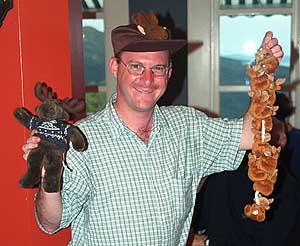
You met Sven (in Dave's right hand) on day 6. It was his job to provide us with good weather by doing a special Moose Dance each evening. Unfortunately he sometimes overindulged and failed to do the dance properly.
Apparently aquavit wasn't the only thing he overindulged in. Dave claimed those little mooses (meese?) in his left hand are Sven offspring. Apparently they shared a common umbilical cord. (Yes, I know the plural of moose is moose.)
Whoever their father was, Dave gave one to each tour member to help us recall wonderful memories of the trip.