Oslo, Norway
Day 14 - Tuesday, 15 August 2000
Dave got us off to a good start in Oslo by taking us on a orientation lecture-walk.
At the City Square we stared at a wonderful statue of King Christian IV while Dave told us the story of the city of Oslo being destroyed by fire in 1624. The King decreed that the town should be moved west and rebuilt, laid out in wide streets which met at right angles. This design, together with a rule that henceforth the houses in the town were to be made of brick and not logs, was meant to prevent it from ever again being destroyed by fire. He named the new town Christiana.
In 1905 the Norwegian parliament voted for independence from Sweden, and the town was renamed Oslo. In 1907 the women won the right to vote in local elections. In 1913, they gained the right to vote in national elections.
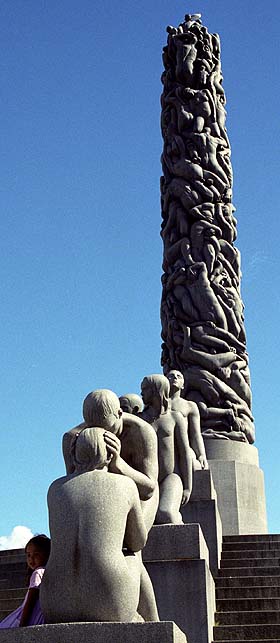
The Vigeland Sculpture Park in Oslo was one of the highlights of the trip. It covers 90 acres and contains 192 sculptures with more than 600 figures, all modeled in full size by Gustav Vigeland (1869-1943) without assistance of pupils or other artists. He also designed the architectural setting and the layout of the grounds.
The Monolith (photo) consists of 121 figures. Three stone carvers worked on the column daily from 1929 to 1943.