Oslo, Norway
Day 15 - Wednesday, 16 August 2000
After a good night's sleep and a lovely breakfast, we headed for the harbor to get an early start. A ferry took us across the water to Bigdoy and the ship museums. Our first visit was to the Fram museum.
The Fram is a famous polar exploration boat built at the direction of a brave, observant and intelligent Norwegian named Fridtjof Nansen. This well-designed and executed boat made two exploratory trips into the Arctic, bringing back a wealth of information for scientists and travelers.
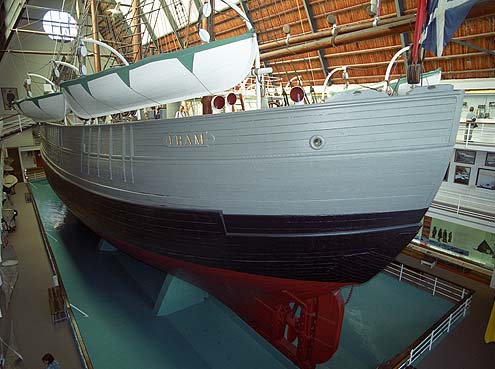
Later she made a trip with Roald Amundsen to the Antarctic. He became the first man ever to reach the South Pole. These stories and more are told in great detail and with many artifacts in this beautiful museum. It is a monument to the courage and intellect of some great Norwegian men.
The Fram sailed to both the northernmost and the southernmost points of the globe. She was launched on October 26, 1892. Fridtjof Nansen set out for the Arctic on June 24, 1893 and returned September 9, 1896. Roald Amundsen sailed for the Antarctic on August 10, 1910. He and four companions reached the South Pole on Dec 14, 1911. They returned to Norway on July 16, 1914.
We were able to go below decks to see how the crew lived.
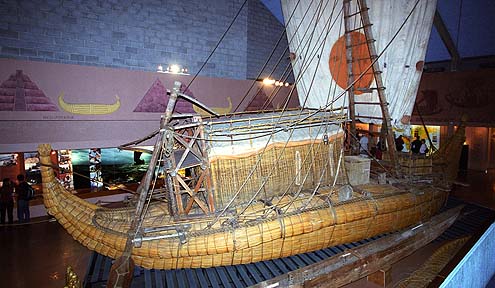
After inspecting the Fram we crossed the street to the Kon-Tiki Museum where we got to see the original balsa raft that Thor Heyerdahl and companions used to cross the Pacific from Peru to Polynesia in 1947. We also saw the only existing cast of a thirty foot tall Easter Island statue
The Open-Air Museum at Norsk Folkemuseum in Oslo was established in 1894. There are 150 buildings collected from all over Norway. The long building in the picture is actually two barns, a cow barn and a hay barn. The small building is a privy. Sod was the most common roofing material in Norway from prehistoric times to about 1900.
The largest building is a loft from Søndre Tveito in Hovin ca. 1300. "The loft is well preserved and an exquisite example of medieval architecture. The motifs around the door are influenced by medieval church art. The ground floor was used for storing food. An enclosed gallery covers the upper story where textiles and other valuables were kept. Tar crosses are painted on the door to protect the contents. There is a medieval bed in the upper story. The loft was presumably lifted onto posts in the 1700s."