Eastern Turkey
Day 2 - Tuesday, 20 June 2000
We fly to Ankara, then on to Kars near the Armenian border
Our day began early with a flight to Ankara in the middle of the country where we changed planes and headed for the eastern city of Kars near the border with Armenia. Metin, Meli's driver, met us at the Kars airport with the Melitour bus. His smile and hugs indicated how happy he was to see each of us again. All but one of the people on this tour have been on previous tours with Meli, and to Metin it must seem like old friends coming back for a visit. We were equally happy to see him. It is very good to see a familiar face in a strange land.
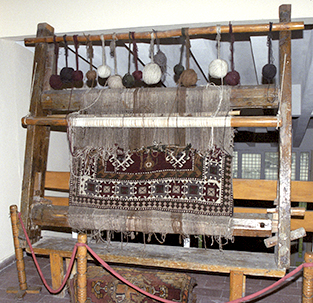
This old carpet loom is one of many very interesting exhibits in the
small museum in Kars.
We have visited several small but delightful museums in our travels in Turkey. The museum in Gazi Antep is particularly notable.
From the airport, Metin drove us first to the hotel. After we checked in to our rooms, we went to the small but very impressive museum. It was necessary to get permission from the authorities here for our visit to Ani. Our time in the small museum was brief - too brief, because there are questions unanswered in our minds. One display indicates habitation from the time of the dinosaurs, and we're not sure if the implication is that human and dinosaur bones were found together, or if it is someone's idea of fun to display them in the same case.
Ani
From Kars, Metin drove us to the ruins of the ancient city of Ani on the Armenian border. Someone had heard on the morning news a story of an Armenian who was killed just yesterday crossing the border into Turkey. The soldiers called out for him to stop and he would not, just kept coming. They shot and killed him. The details of this action were pretty sketchy, but Meli gave us some background. The peace talks had just begun, and it is possible that the sucidal action of the man was political in nature, designed to disrupt the process. Meli promised to tell us the story of the Armenians at a later time. Ani awaits.
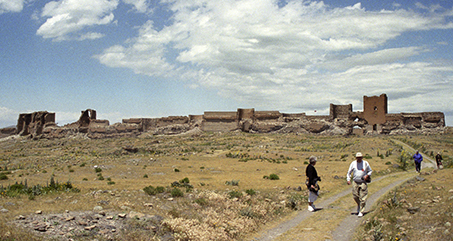
The old wall stands, massive and intimidating. It seemed more brooding perhaps than it really is, because we had by this time been told several times, warned really, not to take any pictures with cameras pointed toward Armenia. There is a large sign just outside the wall, repeating the warning. This means no photo can be taken of the wall, because Armenia is in the background. And once inside the wall, it became even more frustrating to see the old ruins and not be able to shoot them all together from this angle. The hills in the background, you see, are Armenian. So, we walked out past the buildings and shot them from the other side.
Saint Gregory Church
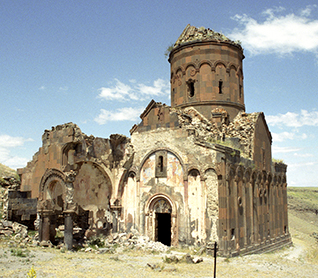
Near the ruins of St. Gregory Church, there is a deep, wide ravine, with a river at the bottom. It is the dividing line between the two countries, and of course its beauty is forbidden photography. If you point your camera that way, the soldiers watching on the opposite hills might shoot you with real bullets. Or at least someone might come and confiscate your film. So we did the best we could.
Meli pointed out the mosque which is the earliest one in Anatolia, dated 1054. It represents the takeover of the Turks in Byzantine land. (The Armenians sided with the Turks against the Byzantines.) Farther over beside the cathedral is the old Zoroastrian temple. There wasn't time to visit them all, so we spent some time in the St. Gregory Church and learned a bit about Armenian Orthodoxy. The roof of the building is mostly missing, and the wall paintings are faded, but still quite visible. The structure of the walls is still quite strong. Meli said that the Turks learned stonework from the Armenians.
Family Visit
We stopped in a small house in the nearby village and visited a family. A photo hangs on the wall, with a doily covering the face. Someone asked why. It seems that it is a picture of the woman's husband, and he wants it there. But she is concerned about the Muslim practice of not representing faces, so she compromises. He can hang the picture, but she covers it with a doily. Oddly, it doesn't seem to be a problem when it comes to a wedding picture of her son and his bride, which sits on a side table.
We stopped on the way back to town to take pictures of a "dung fuel
factory". Women were working the manure, spreading it in the field and
letting it dry a while. Later it will be cut into squares and stacked
to finish drying. The slabs are used for heat in the winter, and
year-round for cooking fuel. A glance at the countryside reveals why it
 is necessary. There are no trees from which they might cut
wood.
is necessary. There are no trees from which they might cut
wood.
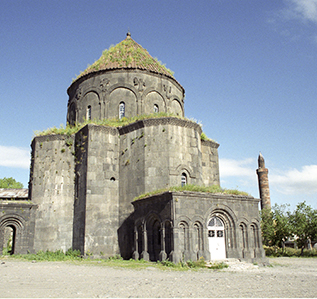
Back in Kars, we visited an abandonded and locked-up "Church of the Apostles," with images of the apostles carved into the stone just under the roof. Nearby is an old bridge, alleged to have egg whites in the mortar.
Dinner was ready for us back at the hotel at 5:30. We were happy for an early night.