Eastern Turkey
Day 6 - Saturday, 24 June 2000
Mount Ararat
We woke early to see the sun rise on Ararat, but I was awake before the alarm went off at 4. The moon was shining brightly on the hills behind the hotel, outside our window. We sat on the balcony and waited until the sun came up and illluminated the clouds, which now crowned the top of Mt. Ararat. There is a smaller peak nearby, called "Little Ararat."

Mount Ararat covered in clouds as viewed from the little village near the site of Noah's Ark.
Noah's Ark
The "ark" is not on the high peak of Mt. Ararat, but on a nearby mountain. We started out in the bus, and changed to a couple of small vans. The long bus cannot negotiate the steep, narrow winding trail up the mountainside. At Meli's request, Mike read the story of Noah and the Ark from the Bible. Then we began the ascent.

These two young Turks live in the village near the final resting
place of Noah's Ark.
We passed by the ark, and proceeded up to the village above it. The people live here year round, in this windy, dusty place. A woman was beating the wool of a mattress to clean it, and three of our people climbed on the roof to take photographs. Cameras were passed up for everyone to get a shot.
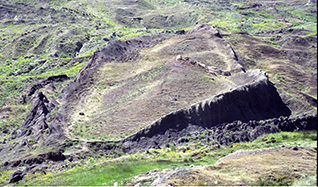
This is the outline of what is left of Noah's Ark. Like many
religious concepts this may require faith to fully
accept.
We drove back down to where the rock formation known as the ark is watched over by a man named Ibrahim. There is a small building there, with some articles and stories. One of the van drivers picked red poppies for the ladies.
Ishak Pasa Palace
After lunch we went to Ishak Pasa Palace, a very dramatic place. It was builit in the 1600s to 1720, and the Tree of Life is a predominant feature in the art of the buildings.
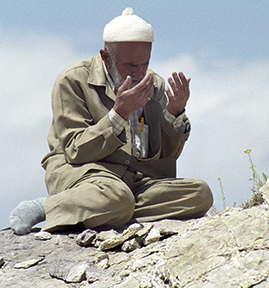
This man was praying on a rock in front of the Ishak Pasa Palace.
The picture was taken from the doorway of our bus.
On the road to Van, we drove through a very pastoral scene, with many groups of sheep grazing. One of the shepherds threw a rock that hit the bus - perhaps just a bored kid.
There is a huge ancient lava flow beside the road, which goes on for miles. We could not see clearly where it came from, or exactly where it ended. Even after the main flow has ended, we continued to see lava as if it just bubbled up out of the ground. The thickest part of the flow was at 8,600 feet. There is a mountain nearby, Mt. Tendurek which is 10,700 feet high. Perhaps it is the ancient source of the lava flow.
Waterfall
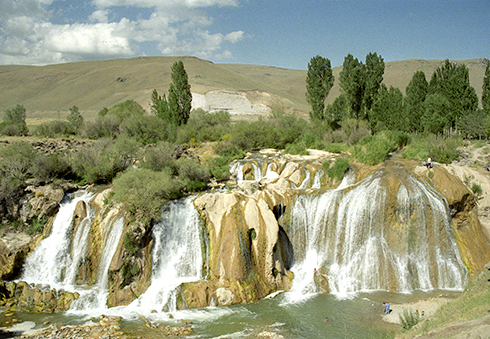
We made a stop at a fantastic waterfall "where the fish jump up backwards" as Meli claimed in her CD presentation.
At Muradiye, we made a house visit. The old man in the home was wearing a sock on his hight hand while greeting us. He had made his ablutions and wanted to stay clean. So he could not touch a woman's hand, but he wanted to greet us. He is 81 years old, and has a brother 86 years old. They came to Turkey from Iran where they had stayed for 5 years, for religious reasons. He wears the fez. He prefers Turkey to Iran, and says that it is Number One in the world. There is terror all over the world, but Turkey has scraped the terror out.
His nephew arrived from a meeting - he was at the waterfall park! The two men differ on their political views as to the solution to Kurdish-Turkish relations. But they tell the story of Ocalan, who said he would establish a Kurdish State. "We will be a state of our own." He told the people. But the State of Turkey did not accept their secession, and civil war began. Ocalan started terrorism. Foreign countries promised him weapons, food and support if he would stop the terrorism. The countries who promised to support them were Greece, Russia, America, Germany, and Syria, said our host.
"Where do you get news?" someone asked. "From television, and from the coffee house" was the answer.
Some of the people joined Ocalan because they wanted to be on his side and thus became his soldiers. Others were kidnapped and forced to serve in his army.
"What should happen to Ocalan?" "Hanging is too good for him, he should rot in the jail."
Turkey has a "repentance law." If a former follower of Ocalan turns himself in, "Here's my gun, I know I did wrong and I repent…" He will probably get only 2 years punishment instead of 10. The repentant soldiers are received back with open arms.
"How many people from this village were soldiers?" One tried to run from Ocalan and was shot in the back. Four have come back.
"Kurds from Iran are not welcomed in Turkey, unless they are fleeing persecution."
The nephew is a civil servant since 1979, and Kurdish is his mother tongue. After the earthquake, the State built him a house, where he lives with wife, 3 boys and 3 girls. He has worked for the State for 25 years. In generations back, his family came from Iran, and he has some relatives who still live there.
"Everyone should have democracy," he said, " and everyone should know their part of humanity."
"As a Kurd, without denying my origin, Kurdish, Turkish, we are all brothers. I had an uncle who died in Gallipoli for this land. With our blood, we bought right to this land."
The political difference between the two men comes to light in a discussion of what language should be used in schools. The old man says it should be Turkish, because everyone needs to know that language, and Kurdish should be spoken in the home. The young man says they should have a choice of Turkish or Kurdish for schooling.
On the bus again, Meli told the story of her arrest in Salt Lake City. You can read the story still, in the internet article on sltrib.com
Uartu Fortress
We arrived at the Urartu Fortress, and climbed the steep paths to the top. A 12-year-old boy gave us the story, which he had memorized.
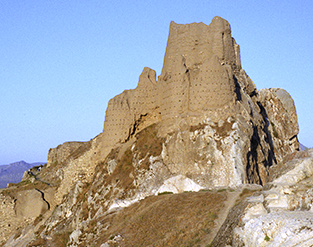
The Urartu Fortress dates from 825 BC, the settlement was called Tushba, the capital of the Urartians. They are the ones who bult the fortress. Later, Seljuks built the mosque and the minaret. The Ottomans restored the old buildings, using ostrich egg white in the mortar. There are 4 mosques, two were Seljuk and have been destroyed. Two are Ottoman and still exist; one is Sinan architecture, the other is Pasa.
60,000 people were killed at Tushba when the Persians destroyed the Urartians. Tushba was restored in 1918.
After the sunset across Lake Van, we descended the hill and went to our hotel, where dinner was served, and we slept.