Eastern Turkey
Day 11 - Thursday, 29 June 2000
Gazi Antep
This was the too-terribly-early-in-the-morning day, when we got up at 2 am to climb Mt. Nemrut. It's not quite as bad as it sounds, because the minivans took us up as far as the road could go. After that we had a choice of our own feet or donkeyback. Esin (Meli's Mom) elected to go by donkey, and the rest of us huffed and puffed and hiked up the rocky path in the dark. Those who had flashlights lit up the path and at last we found our way. Meli, who had done this before, sprinted ahead and reserved seats on the front rock for us. There we were, waiting for the sun to come up and light up the statues. There was laughter and chatter, and some of us moved a little farther away to try and experience this sunrise in silent contemplation. But more people arrived, and soon there was a crowd. Then as the sun rose, it became a juggling act to try and get the photos we wanted, while staying out of each other's way.
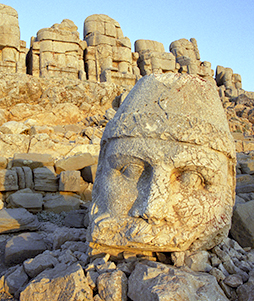
There were statues of lions and eagles, gods and goddesses, and of Antiochos I (69 BC - 31 BC) who had all this built. The very top of the mountain is a huge pile of broken rock, believed to be covering his tomb. (Archaeologists have not been able to locate it, however, even after using dynamite and lowering the top from 75 meters to 50 meters in the process.) This megalomaniac king identifies himself as "Great King Antiochos Theos Dikaios, Epiphanes, Philoromaios and Philhellene, son ofKing Mithridates Kallinikos and of Queen Laodike Thea Philadelphos, daughter of King Antiochos Epiphanes Philometor Kallinikos." Queen Leodike is supposed to be a descendant of Alexander the Great. His kingdom was known as Commagene.
The statues are believed to have been produced by Greek artists who were familiar with the prevailing traditions of both Greek and Persian arts.

As the sun rose, we went round to the other side of the mountain where more of the same statues faced toward sunset. When our camera-snappers were happy, we headed down the hill again. But not before Meli scolded some locals for going off the path and doing damage to the tumulus. If people don't respect the rules, a day will come when there will be nothing here to climb the mountain for.
When we were back at the road again, the minibuses took us part-way down the hill to a restaurant where our breakfast was waiting. After we ate, the minibuses took a different route back to the hotel. We stopped at two bridges, and then briefly at the Karakus Tumulus. There is an inscription at this tumulus which states that it was made for Mithridates II;s mother Isias, his sister Antiochis and her daughter Aka. The statues here are much less elaborate than those of Antiochos I.
We also had an impromptu stop in a small village, where a woman sat on a platform mending a potato sack for reuse. Of course we were immediately invited in and some of us accepted. Others wandered around outside.
Finally we were back at the hotel, with an hour to rest. Then back to the bus and on the road again, heading for Gazi Antep.
Zeugma
Before Gazi Antep, however, we diverted to the flooded ruins of Zeugma. This ancient Greek site was discovered when the villagers began to dig up their apricot trees to move the entire village out of the way of the lake behind a newly built dam. The flood is rising higher, much of the ruins are already underwater. Archaeologists have done some emergency excavations to remove a wealth of mosaics, which we were told are now in the museum in Gazi Antep. We would be able to see them the next day.