Eastern Turkey
Day 5 - Friday, 23 June 2000
Erzurum to Dogubayazit
Outside of Erzurum, we crossed a bridge where women were washing wool and rugs in the river. Mattresses are stuffed with wool, and each spring the women take them apart to wash and air out the wool. It is a family event for women and daughters.
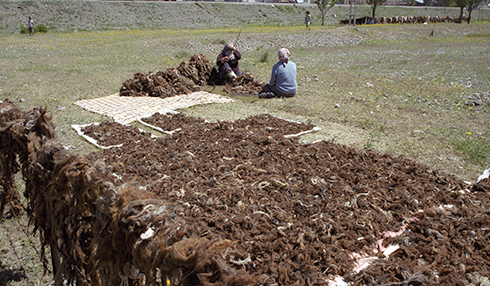
The washed wool is spread out to dry in the sun.
Somewhere further down the road, we came upon another bridge. Meli says it was built by a woman. She was so pleased with its construction that she had one of her most precious pearl earrings hidden in it. It is at the confluence of two streams become one and flow on past, wider and deeper. There were cows under the bridge, sheltering from the midday sun.

These two streams converge at the bridge mentioned above. The
picture was taken from the bridge.
The next stop was for refueling the bus. The station is a new one, being built with marble steps and marble posts, with a marvelous set of restrooms. Too bad they are not yet ready. Inside, someone noticed a map showing Turkmenistan and Uzbekistan. The map was brought to the bus, and Meli used it to show us the locations where the Uzbek tour goes, and to give an overview of the tour. Coupled with the album of photos we had brought along, it was enough to convince several people that it was a tour they wanted to take. Before the end of the tour, they signed up, and Meli's Central Asia tour for 2001 is filled. She already had several people who are going as a group.)
We began to see trucks, many of them, with the word "Mashallah" on the front. They are a petrol pipeline on wheels. At a station, we saw many, maybe 30 or 40 of them, waiting to be used. The word means "God bless you" I was told.
Beside the road, we took pictures of piled stones for boundary lines. Mike remembers the hymn, "here I raise my Ebenezer".
We passed a mountain looking like a wall of tufa, with holes carved in the side. Meli said it was home to the terrorists. On we went through the Karas Aras Dagari mountain range…
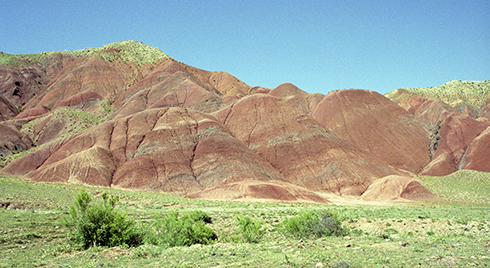
The hills are very colorful and there are dramatic views in every direction for miles and miles.
The terrain we had been passing through had been beautiful, but now the beauty became something otherworldly, as the colors rippled across the faces of the mountains like an artist's palette. Someone likened it the American Painted Desert. We stopped to take pictures, and some made it a rest stop behind bushes. Soon the perceived privacy of the bushes vanished as men came toward us from a nearby settlement. It did not seem large enough to be called a village, but was more like a few farmhouses scattered along the edge of the fields. One of the men had flaming red hair, and Meli took his picture against the matching background of red hills. Soon he convinced her that we should all stop in his home for tea.
This stop was astonishing to us, as we observed the apparent richness of the furnishings inside. Sofas and chairs were there instead of the traditional carpets and pillows. The tea, however, was served in exactly the same way as in all the other homes where we have stopped. Tulip glasses with strong dark tea sit in little saucers, cubes of sugar are offered, and tiny spoons are available for stirring.
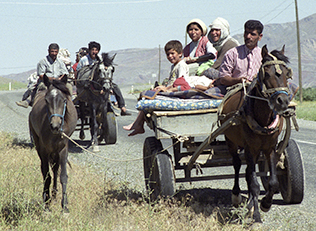
Horse carts are common in rural Turkey. These people do not worry
about the price of gasoline.
Carolyn asked why we have not seen babies. We have seen children, ages about 2 and up, but no newborns or small babies. Immediately one of the young women ran off to the village to get some babies for her to see! We were ready to go however, before she returned and started to put our shoes on. (It is customary to leave your shoe outside the door so no dirt is tracked into the carpeted interior.) Wendy couldn't find her shoes. Soon it was discovered that the woman who went to get the babies had slipped her feet into Wendy's shoes. We could not leave until she returned, with two babies to show!
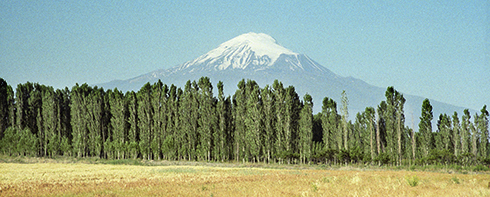
Late in the day we approached Mt. Ararat, and were able to see it clearly, not at all obscured by clouds.
We slept at Hotel Sim-Er, where we ate soup made of three herbs. Mint, fennel, and a plant called "plant for food."