Eastern Turkey
Day 8 - Monday, 26 June 2000
Eight hour ride to Diyarbakir, see Tigris River
We departed from Van at 7:30 a.m., and before we were far from the city we stopped to take a photo of watermelons being sold under the shelter of a black tent. Just beyond the tent was a stonecutters lot, and Meli had great interest in the products there. Back on the bus, Meli shared with us the reason for her interest. She has recently acquired some property in Ephesus, and has plans for modification of the existing dwellings, including a kitchen and a colonnaded patio beside a pool. Meli and her mother have already designed the patio, which includes three pillars of red stones with capitals to support the ceiling. The red stone here is tufa from the volcano, and will be easy to carve.

Our next stop, some time later, was in a highland hayfield. A man, his son, and an uncle were busy cutting and piling hay, using a spinner to make a rope of the hay - the rope will be used later to tie up the bundle when the hay is completely dry.
The man showed us his tobacco, a bright gold leaf chopped fine for roll-your-own cigarettes. The fragrance of the leaf is clean, aromatic, and without chemical overtones.
Two oxen stood nearby, looking at us with some trepidation, ready to flee if we threatened them. We took pictures, but kept a respectful distance.
At 11:30, we came upon a roadblock. A produce truck had tried to negotiate a narrow pass in a place where the road was under construction, and failed. The trailer was tipped over the side of the road, and all the produce scattered down into the roadside stream. Some boys were collecting tomatoes, and others were watching, as we did, the efforts to clear the trailer from the road. It took some time, and there was some grousing from people on the bus, about why it wasn't done more quickly. Mike quoted an old boss, "Nothing is impossible as long as it is someone else's responsibility." This proved also to not be impossible, and eventually the trailer was dragged out of the way. In a few moments, we were on our way again.
We went down through a dramatic gorge, where the formation of the rock was like that of crystals.
Bitlis
At the entrance to Bitlis, the soldiers stopped us, and warned that the people might not be nice to us. We stopped in the town anyway, and almost everyone got off and spread out to shop. But the warning turned out to be true. At least three of the women experienced being treated with disrespect. This was not a friendly town.
The people in the streets were mostly men, very few women. The women we did see were quite covered up.

At a Jandarma (police) stop, a donkey in the road helped block our passage.
Meli told us that in previous visits, the right side of the road was lined with tanks pointed toward the hills on the left side of the road, where the terrorists were hiding out. Those tanks are no longer here, more evidence that the terrorism is "finished."
Traveling down the road, we noticed that the housing looks different. At a fuel stop, we experienced the heat hitting us full in the face as we stepped off the bus. The people here are not as warm, however. They are more guarded.
On the road again, Meli put a tape in the player, of a Turkish singer named Abrahim. His style is mournful and tragic, the instrument sounds a shrill wailing. It seems to fit the feeling of the desolate land and the stony ground.
The landscape is dry and brown, like California hills in the summertime. In the low places, and where the river provides moisture, the tobacco fields provide a green relief against the brown. The plants are short, the leaves bunched together. It is very different from the tall plant that grows in the American south. The method of cultivation is also different. In the American south, the plants are planted on the top of the "row" or mound of dirt. Here, the plants are in the low part of the plowed row, almost on the side of the mound. I believe it is called the "aromatic" tobacco plant.
Interspersed in the mix of fields were hay fields. This hay looks different from the hay we saw in the highland hayfield. There are fewer wildflowers, and more seed-bearing grasses.
Malabadi Bridge
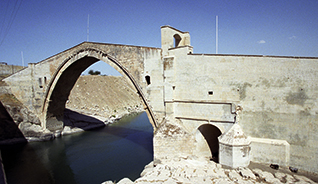
We stopped at the Malabadi Bridge, a stone bridge built in the 12th century. A bridge built in the 1950s carries traffic. The Batman River flows beneath.
Under the old bridge, goats rested in the shade, sheltering from the hot sun. When we got out for pictures, Meli ran into another tour group and spent some time exhorting them. They are a group of Turks from Istanbul, she had seen them at a previous stop. She is quite anxious that the Turks tour their own land, and had encouraged them to travel farther east. She was very happy to see them here.
We began to see machinery for mowing and threshing, as the fields grew larger and the land flatter. By 4 PM, it seemed that we had entered into a great, vast, empty and echoing land. Just after 4:30, the echoing emptiness gave way to orchards of fruit trees.
We spent the night in Diyarbirkir, where many of our fellow travellers shopped for goat hair rugs.