Eastern Turkey
Day 3 - Wednesday, 21 June 2000
We all woke around 4:30 AM, thinking it was time to get up, but discovering it was a time zone thing, we went back to sleep. Turkey covers enough territory that it should be two time zones, but they prefer to have only one. So Eastern Turkey has very early sunrises. The sunrise today was at 4:36 and the sunset was at 7:41.
We started today's drive about 8:30 AM. We drove north up around Lake Childer then southwest to Erzurum via Gole. The reason for the opposing directions was to maximize of the variety of scenery we would see.
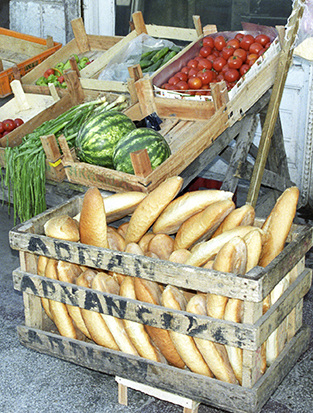
On the way out of town we stopped at a small market to pick up
picnic supplies. This is how bread is sold all over Turkey.
Soon we stopped to take pictures of wool drying. It would not be the last time. All over eastern Turkey, spring has arrived and people are washing wool and carpets.
On the bus, Meli ventured to tell us a bit about Armenian history. It is painful, long and layered. Meli reminded us that history cannot be created from the clear blue sky, but it is derived from archeology and from archivists. If you see only one part, it is limited and incomplete. She hopes to give us a fuller picture than we have received in the west.
Ani was a princedom of Byzantine Anatolia, and in those days political identities were measured by a different standard - it was by ethnicity and religion, not necessarily geographical. For example, the Armenians could be workers in the palace, doing stonework, etc. The Greek Orthodox people were traders and seamen. The Turks performed the military service and paid lower taxes than the others. They lived in the city-states in balance, whether Greek Orthodox, Armenian Orthodox or Muslim.
The trade route came through here, and the British, French and Italians wanted to partake in the riches of the area, so they also came and settled, bringing with them the Catholic identity, which made one "nation" of the three different peoples. By the 1500s, this group had an advantage. With renaissance, reforms and enlightenment providing them an economic advantage, they were controlling the trade. The other people could see that by changing religion, they could change their class, so Armenians began breaking away and becoming Catholic. This was the first of the divisions to arise among the Armenians.
Another power was rising - the Protestant world in the U.S. and Hawaii. Strong religious authority leads to political and economic authority, Meli told us.
In Trabzon, the Protestants were carrying out missionary work, and the Armenians were open to conversion and a hopeful future. The Catholics and the Muslims were less vulnerable. This was the second division to affect the Armenians.
Britain and France were losing in World War I, and the British philosophy of "Divide and Rule" was brought into play. They gave the Armenians weapons to use against the Ottoman Turks. By this the British sought to use Armenia as a buffer state. In the Turk-Armenian war a million Armenians were killed. Armenia was subsequently taken over by Russia and became part of the Communist system. Many Armenians migrated south. The Protestant Armenians were rescued by American Protestants and taken to the U.S., but the Catholics experienced no such similar rescue.
The Armenian story is not finished, it is an ongoing situation. Our hopes are for a peaceful solution!
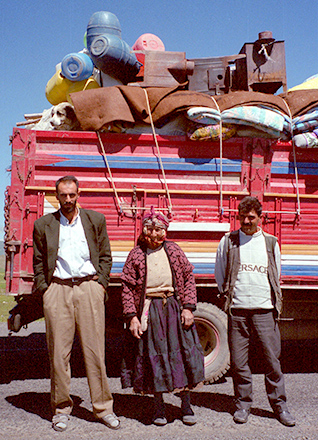
We stopped to take photos of nomads with a heavily laden truck.
Note the dog above the man on the left.
Across the road was a shepherd with with his sheep, his dogs,
and beautiful blue Lake Childres. The altitude here was about 7,000
feet.
Nomadic life was suppressed during the Kurdish difficulties, to protect the nomad families from the terrorism. The suppression lasted about 12 years, and Meli is happy to see the nomads moving about again. It is the first of many signs that the war of terrorism (Mike called it their civil war) is over.
We picked up two people who were traveling to a nearby village and gave them a ride. Somehow it didn't occur to us to take their picture. They told us about the Yilah, the higher places in the mountains where they take the herds in the summers so that they can graze. The woman was wearing oya lace on her scarf, she said her daughters make it for her. Meli asked what was their biggest problem: The woman said "hard work", her son said "the scarcity of water."
A discussion arose - what exactly is hay, and how is it different from straw, wheat, chaff?
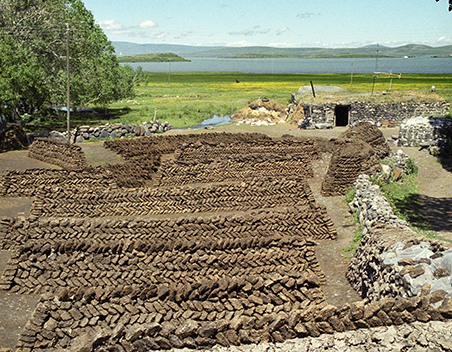
We made another dung photo stop, and a man came from his house to offer us tea, but we had to hurry on.
We stopped to take a photo of a gate on which it is written - "While we have a stone we will not be divided."
We drove into a grand emptiness, with rolling hills all green and yellow. In the valley there were sheep, but there is a vastness to this place that seems to have echoing loneliness. Beyond these rolling yellow hills is the country of Georgia.
Meli used this desolate land to illustrate the differences in Western and Oriental views. From the west is the myth of Prometheus, who found the sacred fire and gave it to humans. To punish him, the gods had him bound in these Caucausas mountains where birds ate his liver every day, only to have it grow back at night, so that he is in eternal torment. For the Western mind, this is the end of the world.
From the east comes a different myth, the bird in this myth is a symbol of hope and beauty, with a green head, red wings, orange tail, and it brings good news. It comes from this most beautiful of places. So to the Oriental mind, these Caucasus mountains are where goodness starts.
About this time we saw gypsies, and the subject came up for discussion, as it always seems to do on these trips. Meli says that the Turks see gypsies differently than our American stereotyped image of them, and she compared them to blacks in America. They are people with ethnic and cultural differences. These differences create insecurities in the communities in which they live. The gypsies, she said, are freedom lovers who think they are good musicians (but they are not).
Other people chimed in to tell stories of their own experiences with Gypsies. The gypsies of England meet in the North of England each year in June for an annual fair.
Someone recommended the book "Mary meets Stanley" which is about gypsies.
What is the difference between a village and a town? In a town, they count the people to get the size, in a village they count the houses. Town people do not produce goods, but act as middlemen and distributors. Villages are self sufficient, self-sustainable, and sell their excess goods to the people in the towns.
High in the mountains we stopped in a village that seemed deserted, at first Meli thought it was the Yilah, and people had not yet arrived. But when we stopped, we found that it was the village, and most of the people were gone even higher to the yilah. In the gardens potatoes and beans were growing, and a young girl came running with a handful of greens to offer a bite. It was an interesting taste, which no one could identify.
A stream flows beside the road. "Remember this stream" Meli said, "and I will talk about the Garden of Eden." Later when she did talk about it, I found myself wishing she had done so at this point. People talk about the Garden of Eden being "between the Tigris and the Euphrates," but that's not quite how it reads in the Bible.
Gen 2:10-14
10 Now a river went out of Eden to water the garden, and from there it parted and became four riverheads.
11 The name of the first is Pishon; it is the one which skirts the whole land of Havilah, where there is gold.
12 And the gold of that land is good. Bdellium and the onyx stone are there.
13 The name of the second river is Gihon; it is the one which goes around the whole land of Cush.
14 The name of the third river is Hiddekel; it is the one which goes toward the east of Assyria. The fourth river is the Euphrates.
NKJV
I understand that Meli wanted us to experience the black stone and the gold to bolster her position that the Garden of Eden is truly in Turkey and not in Iran as some claim. But I was already of the opinion that the rivers of Tigris and Euphrates flow OUT of the Garden, rather than it being positioned between them. Of course whatever the geography was at the time of Adam and Eve, it has changed since then. No one today even pretends to know where the Pishon and Gihon rivers are located. Tradition is easier to create around something that is known and can be pointed out, and that seems easier to believe than words which have been written and passed down through all these thousands of years. The attitude toward the Bible seems to be, if you can't physically prove it, it must not be true. No one believed the Biblical account of the Hittites, for example, until the Hittite cities in Turkey were discovered in the last hundred years.
Anyway, I would like to have stood there in that village, and looked at the stream, and imagined that in just such a place might Adam and Eve have found themselves, and disobeyed God's command, rejecting His authority over them. The soil looked very rich, the gardens were lush, and the children's faces were flush with life. High in the mountains of Switzerland we found the same kind of healthful environment.
But the Bible tells us that the Garden of Eden is no longer accessible to man, and trying to return there is like a child trying to return to the womb. It is not possible. Our direction is not backwards but forwards. Here in this place, climbing up the mountain and rolling down the other side, looking at the incredibly beautiful mountains, I found myself singing in my heart the hymn, "How marvelous, how wonderful,…."
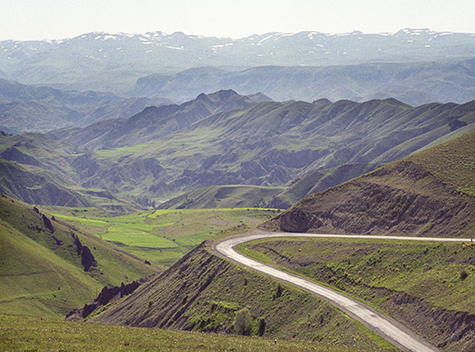
We reached a peak of 8000 feet. Mike gave the opinion that at this height, the cows must give evaporated milk.
Carolyn, who has traveled a lot as a guide to the Sierra Club, said that she had never seen "such a variety of terrain in one day."
The mountains before Gole are called the "God is Great" mountains, said Meli.
Meli took us to visit a waterfall, she wanted it to be a surprise. It was a surprise, there was no water. The water has all been diverted to feed a dam. But the contorted stone cliffs and sheer mountainsides that we saw as we traveled through the canyon made at least the first part of the trip worthwhile. We photographed a fort perched on a sheer rock. How did they DO that?
As we returned, and were leaving the canyon behind, two soldiers stopped us, one of whom carefully checked each of our visas. The other laughed at him the entire time. It seems the first soldier had just arrived at this post where he will spend the next 18 months, and the second soldier was nearly done with his tour of duty. The first young man was exercising his authority, "because he could."
We arrived at the hotel to learn sad news. The hotel owner had died a few hours earlier of a heart attack.
As soon as we were settled, we had dinner at the hotel.