Eastern Turkey
Day 7 - Sunday, 25 June 2000
Van
Van has been an important center since the time of the Urartians. Many villagers have been evacuated to this city since terrorism started. (Their villages were destroyed to eliminate support for terrorism.) The State built a university, enlarged the airport, started use of a ferryboat, and enhanced train service. They also established theatres and opera. Lake Van is a source of salt and sodium.
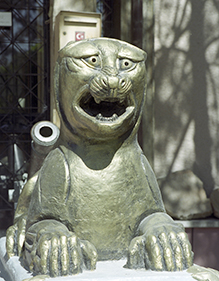
We visited a museum, to learn of the prosperity of Van and its deep-rooted culture. Since the Stone Age, the Neolithic period, 5 million years B.C., there has been "uninterrupted" civilization here. Van has been the capital of succeeding dynasties, as the Urartians succeeded small clans. After Catalhoyuk, the oldest woven materials were found in Van.
The ancients engineered aqueducts that are still being used by the city today. The water comes from the mountains that stand between Turkey and Iran. The wheel was in use here in very early times, giving the people superiority in war and in trade. 800 years before the Romans, they had chariots. They had a continued relationship with Egypt, and borrowed Egyptian techniques and symbols, seen in their metalworking, jewelry, gold filigree, and dangling earrings.
2000 years before the Venetians, the people living here had fired glass. One display shows beads of glass, agate, metal and stone.
There are bracelets, one is like a copy being worn by Meli. It has double snakeheads. Meli says a statue of Artemis in Ephesus shows her wearing the same thing.
A metal display holds cast iron metal pieces used in a horse's bridle, including a bit for the mouth. In Toprak Kali, Meli told us, a 3000-year-old pot was excavated - still containing wheat! Cast iron Urartian helmets are on display, their peaked tops perhaps providing a bit of air to a sweaty soldier on the battlefield.
The Iskits replaced the Urartians, and their dynasty is marked by copper votive pieces and bronze dishes, as well as belt armor which is 6 to 8 inches wide.
We saw "evil eye" charms in necklaces dated to 1100 BC.
"Anatolia" said Meli, " is symbolized not by the bride, nor by the cradle, but by the sieve. Like a sieve, it allowed certain cultural emblems to go through, while other s, like the evil eye and the snakehead bracelet, remain."
Cuneiform writing provides much information to archeologists.
Upstairs in the museum, there is a "genocide" display. This tells the Turkish side of a massacre. Five women and four men were killed, and their bodes found at the Zeve ruins. A storyboard relates the event and reports that "8 were of Alpin race, and 1 was dinarlic race." I don't know what is meant by these names, but the display is meant to indicate that the Armenians were murderers of Turks.
Kurdish Dancers
We went out to a meadow beside Lake Van for a picnic lunch, and were accompanied by a troupe of college students who give us a show. Wearing colorful costumes they performed a traditional dance to the music of drum and flute.

After lunch, we boarded a boat to go out to Akhtamar Island. The 1,100 year old Armenian Cathedral of the Holy Cross, with many carvings and paintings, held our interest for a while. Before we headed back to shore some in our group took a swim in the very alkaline thus buoyant waters of the lake.
We visited a carpet and kilim shop, and heard more interesting stories. The shop owner is Kurdish ( it seems that everyone here is Kurdish) and he told us that where there were 350 villages of his tribe, today there are five. The people were all evacuated and their villages destroyed. The apartment buildings on the edges of town provide housing for them, very different from their village life. Most of the people would go back to the village if they were allowed, he said. If they were permitted to return and rebuild their homes, the population of Van would return to its pre-terrorism size within two years.
Most of the carpets he offers us are old ones, being sold by these uprooted people. Some are new ones, as they are trying to develop an industry to support the tribe.
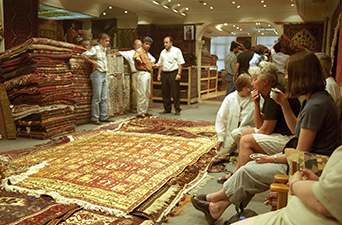
The carpet showroom in Van.
As carpet salesmen usually do, he seeks to educate us about carpets. The dyes are all natural dyes. Of the traditional dyes, only three can be obtained today because the people are only allowed to go three miles out from the city. Red, for example, is traditionally from the root of a poisonous fruit, which grows far from the city. So cherry is being used for red in the new carpets, and it is brighter, not as rich as the old one. Orange can no longer be used, because the source of orange is a very large species of rhubarb - not available in the city. Black is from a nut, brown from chestnut, green from a water moss, and blue is from turquoise.
All of these colors must be fermented in order to properly dye the wool. In the old days, the fermentation agent was the urine of a girl between the age of 6 and 9 years. Today they use the urine of a goat. The dye substance and the urine is placed in a pot together for 24 hours, then the wool is added. For a light shade, the wool is left in the dye for 12 hours, for a darker color, 24 hours. Because of the odor, the dyeing process take place far away from the house. When the desired shade has been achieved, the wool is first dried, then washed, 24 hours it is left in the river to wash away all traces of the urine. Ninety percent of the people are Muslim, and the wool must be clean. It is then spread in the sun to dry again, before being woven. First quality wool is made into kilims, second quality is used for carpet, and third quality is used to make Yilah tents.
Carpets were spread, one atop the other, as he told us stories about the origins of each one, or the symbolism of the design. Then one by one, the carpets are taken away. If you like one of the carpets, you let them know and they bring it to you to make a decision later. When all the carpets have been rolled away, it is time for serious negotiations. Several people went home with one or several precious memories to spread on their floors or walls at home.
Someone later asked Meli, "Why are there so many old carpets for sale?" Her answer was as usual, not a simple one. It is a story, about what happens when people have babies. There are three things that happen as investment for the newborn. First, they plant at least one poplar tree, which can be used when the child and the tree are both grown, to build a house for the child. Second, they buy gold as an investment. Often, gold is given as a gift to the newborn. Third, they make or buy a carpet for the child - it is another investment. When the child is grown the gold and the carpet can be sold for cash. So carpets are not always the emotionally charged items they might seem to be. They are an investment, a commodity.
At a later time, Meli told us that the kilim man was also the one who arranged the picnic. His son will get education, swimming lessons, field trips. The girls will not have those opportunities.
The entire city had a power outage, but our hotel transitioned to its own generator, and our dinner continued without missing a beat.